Dry or traditional construction: what changes on site
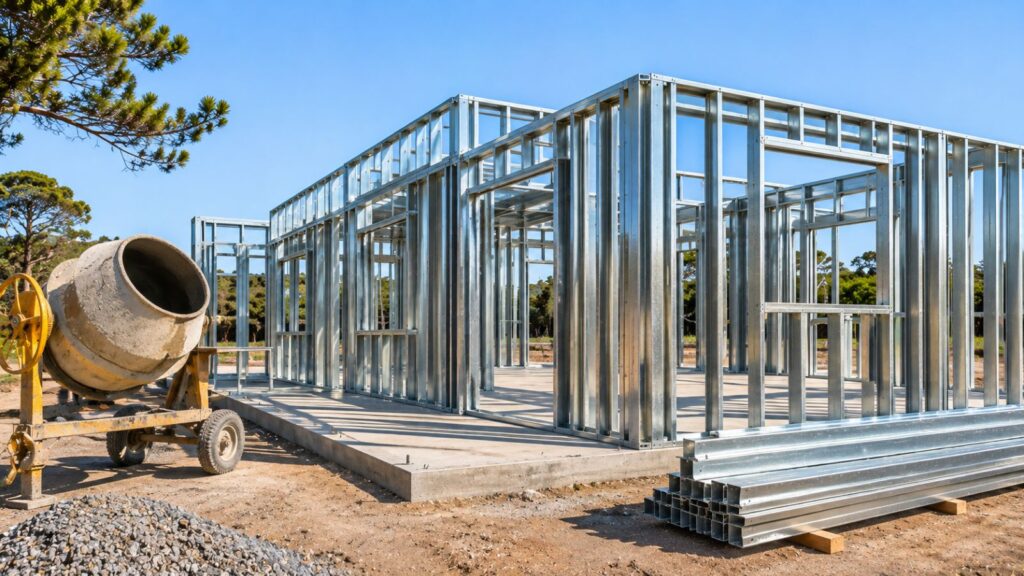
Short answer: traditional construction raises the house on the land with concrete, brick and mortar, which need setting time; dry construction assembles industrialized pieces that arrive ready and are fixed on site. The most visible difference is in how the work is done: dry, the build is faster, cleaner and tidier, with less wasted material.
What each way of building looks like
Traditional construction
- Structure: reinforced concrete and brick or block walls.
- On site: mixing, raising and waiting for each stage to set.
- Finish: plaster and paint over the masonry.
Dry construction with SteelPanel
- Structure: self-supporting galvanized steel panels manufactured at the plant.
- On site: the panels are fixed to the slab and screwed to each other.
- Finish: cement board and texture outside, gypsum boards inside, with insulation in between.
The differences you notice most
Build time
Because it does not depend on setting, dry construction moves forward without waiting between stages. The SteelPanel system is designed precisely as a simplified model that speeds up the whole construction process.
Tidiness and cleanliness
On a traditional site there is sand, cement, bricks and rubble on the land. On a dry site, panels arrive identified for each wall and are assembled with fixings: the site stays clean and tidy, and material waste is much lower.
Precision
Industrialized pieces are manufactured with controlled measurements. That shows in straight walls and openings that fit, and reduces adjustments on site.
Sustainability
The SteelPanel system eliminates the use of cement and mortar in its composition, which reduces energy and water consumption on site.
Maintenance and renovations
Both ways of building need finish maintenance over time. In dry construction, installations run inside the walls and renovations are planned from the project.
When each one makes sense
- Dry construction: if you want shorter timeframes, a tidy build and an industrialized system for houses or commercial units of up to two floors.
- Traditional: if the project exceeds two floors or needs special structural solutions.
To learn about all the dry systems, read our guide to dry construction in Uruguay. And if you are thinking of building on the coast, see prefab houses in Punta del Este: what to know first.
A dry wall, layer by layer
From outside to inside: 10 mm cement board, zinc-coated steel panel, 50 mm glass wool and gypsum board (or cement board in bathrooms and kitchens). Everything is placed with fixings, with no mixes that have to set. That is why the build is cleaner and the result more precise.
Frequently asked questions
Which is faster, dry or traditional construction?
Dry construction is usually faster because it does not depend on setting times and the pieces arrive manufactured, ready to assemble.
Is dry construction cleaner?
Yes. Since it is assembled with industrialized pieces and fixings, the site generates much less rubble and waste than a build with concrete and brick.
Can a two-story house be made with SteelPanel?
Yes. SteelPanel is designed for houses and commercial buildings of up to two floors.
Does Dreams House work with traditional construction?
Dreams House builds with the SteelPanel system, from the project to the final assembly on the land.